I think it's funny that my last week of reading for this class is from Dante's Inferno, the story that inspired my storybook project. I guess that really shows that things have come full circle this semester. Without further ado, let's dive into the reading. The stories are written from the first-person point of view, which gives the reader an inside look at Dante's perspective and feelings. I think Dante's personality fits his character: he's young, innocent, and looking for guidance. As a result, a lot of the language is tailored to fit that personality. Virgil, meanwhile, provides that steady guidance as they advance through the nine circles of hell. One aspect of Dante's storytelling that I found really unique was the inclusion of characters from different historical times. For instance, the first circle of hell, limbo, contains a variety of characters ranging from philosophers like Socrates to heroes like Hector. I also think we learn a lot about Dante through this aspect of the story as well: he recognizes all of these people, and he's not completely oblivious to everything that's happening.
Showing posts with label Reading. Show all posts
Showing posts with label Reading. Show all posts
Thursday, December 5, 2019
Reading Notes: Dante's Inferno, Part A
Story source: Dante's Divine Comedy, translated by Tony Kline (2002).
I think it's funny that my last week of reading for this class is from Dante's Inferno, the story that inspired my storybook project. I guess that really shows that things have come full circle this semester. Without further ado, let's dive into the reading. The stories are written from the first-person point of view, which gives the reader an inside look at Dante's perspective and feelings. I think Dante's personality fits his character: he's young, innocent, and looking for guidance. As a result, a lot of the language is tailored to fit that personality. Virgil, meanwhile, provides that steady guidance as they advance through the nine circles of hell. One aspect of Dante's storytelling that I found really unique was the inclusion of characters from different historical times. For instance, the first circle of hell, limbo, contains a variety of characters ranging from philosophers like Socrates to heroes like Hector. I also think we learn a lot about Dante through this aspect of the story as well: he recognizes all of these people, and he's not completely oblivious to everything that's happening.
I think it's funny that my last week of reading for this class is from Dante's Inferno, the story that inspired my storybook project. I guess that really shows that things have come full circle this semester. Without further ado, let's dive into the reading. The stories are written from the first-person point of view, which gives the reader an inside look at Dante's perspective and feelings. I think Dante's personality fits his character: he's young, innocent, and looking for guidance. As a result, a lot of the language is tailored to fit that personality. Virgil, meanwhile, provides that steady guidance as they advance through the nine circles of hell. One aspect of Dante's storytelling that I found really unique was the inclusion of characters from different historical times. For instance, the first circle of hell, limbo, contains a variety of characters ranging from philosophers like Socrates to heroes like Hector. I also think we learn a lot about Dante through this aspect of the story as well: he recognizes all of these people, and he's not completely oblivious to everything that's happening.


Wednesday, November 20, 2019
Reading Notes: Ashliman, Part B
Story source: The Grimm Brothers' Children's and Household Tales translated by D. L. Ashliman (1998-2013).
The first story, "The Fox and the Cat" reminded me to an extent of one of Aesop's Fables, albeit with a slightly more gruesome ending. Right from the bat, you get a sense of these two characters' personalities: the cat is the humble, curious creature, while the fox is cunning yet cocky. This attitude comes back to bite the fox when he is captured by the dogs, all while the cat is comfortably sitting up in a tree. I felt like the story was trying to convey some kind of moral, like they're trying to demonstrate the flaws of arrogance. One story in particular that really stood out to me was "The Duration of Life". I thought the Grimm Brothers did an incredible job at personifying the stages of human life through animals. The donkey's lifetime represents the working life of the human, while the dog represents their time in retirement and the monkey's life represents their older life. You also find out a lot about the Grimm Brothers themselves; their faith is clearly represented in this story as well as their perspective on mankind. That's not something I can particularly replicate, but I think the story itself is one I could definitely play with. Overall, this was definitely one of my favorite reading units of the semester. The stories were easy to follow yet so descriptive at the same time, and the plots were all very interesting.
The first story, "The Fox and the Cat" reminded me to an extent of one of Aesop's Fables, albeit with a slightly more gruesome ending. Right from the bat, you get a sense of these two characters' personalities: the cat is the humble, curious creature, while the fox is cunning yet cocky. This attitude comes back to bite the fox when he is captured by the dogs, all while the cat is comfortably sitting up in a tree. I felt like the story was trying to convey some kind of moral, like they're trying to demonstrate the flaws of arrogance. One story in particular that really stood out to me was "The Duration of Life". I thought the Grimm Brothers did an incredible job at personifying the stages of human life through animals. The donkey's lifetime represents the working life of the human, while the dog represents their time in retirement and the monkey's life represents their older life. You also find out a lot about the Grimm Brothers themselves; their faith is clearly represented in this story as well as their perspective on mankind. That's not something I can particularly replicate, but I think the story itself is one I could definitely play with. Overall, this was definitely one of my favorite reading units of the semester. The stories were easy to follow yet so descriptive at the same time, and the plots were all very interesting.
 |
| God granting Man more life in "The Duration of Life". |
Tuesday, November 19, 2019
Reading Notes: Ashliman, Part A
Story source: The Grimm Brothers' Children's and Household Tales translated by D. L. Ashliman (1998-2013).
The first story, "Cat and Mouse in Partnership", was kind of odd in terms of how the plot developed. The two animals become friends and share a shelter together during the winter, yet the cat continuously betrays the mouse and eats all the food they stored. He is essentially rubbing it in the mouse's face, yet the mouse is too gullible to realize it until it's too late. I think the author was trying to showcase the personification of the two animals more than anything. I really enjoyed "The Seven Ravens", though! The author introduces the seven brothers early on, but then they don't reappear until the end of the story. By doing so, he succeeds in keeping our attention as the plot moves along. It also helps focus on the protagonist and her development throughout the story. As a whole, the stories aren't incredibly descriptive. Instead, the Grimm Brothers focus on the plot itself. It's very fast-paced, and the plot is very intricate leading to the climax. That's definitely something I will have to incorporate in this week's story.
The first story, "Cat and Mouse in Partnership", was kind of odd in terms of how the plot developed. The two animals become friends and share a shelter together during the winter, yet the cat continuously betrays the mouse and eats all the food they stored. He is essentially rubbing it in the mouse's face, yet the mouse is too gullible to realize it until it's too late. I think the author was trying to showcase the personification of the two animals more than anything. I really enjoyed "The Seven Ravens", though! The author introduces the seven brothers early on, but then they don't reappear until the end of the story. By doing so, he succeeds in keeping our attention as the plot moves along. It also helps focus on the protagonist and her development throughout the story. As a whole, the stories aren't incredibly descriptive. Instead, the Grimm Brothers focus on the plot itself. It's very fast-paced, and the plot is very intricate leading to the climax. That's definitely something I will have to incorporate in this week's story.
 |
| The Seven Ravens. |
Wednesday, November 13, 2019
Reading Notes: Alice in Wonderland, Part A
Story source: Alice's Adventures in Wonderland by Lewis Carroll (1865).
Another week, another reading unit to look forward to! I feel like everyone has seen the Alice in Wonderland movie, but not many people (including myself) have actually read the story. One thing that really stands out to me is how descriptive the writing is. I could practically paint the scene in my head because of all the vivid imagery. For example, in "Pig and Pepper", Lewis Carroll describes the Footmen in detail, down to the "powdered hair that curled all over their heads". I also think the story is unique because there are instances where the plot stalls to dive into Alice's thoughts. For example, in "Down the Rabbit-Hole", Alice thinks about where she might be going, whether her cat will miss her, and more. I think that allows the writer to show a little more of Alice's personality, which is a feature I'd like to include in my writing. As the story goes on, Alice's true character shows: she's an innocent girl, but she is courageous enough to embark on this mission at the same time.
Another week, another reading unit to look forward to! I feel like everyone has seen the Alice in Wonderland movie, but not many people (including myself) have actually read the story. One thing that really stands out to me is how descriptive the writing is. I could practically paint the scene in my head because of all the vivid imagery. For example, in "Pig and Pepper", Lewis Carroll describes the Footmen in detail, down to the "powdered hair that curled all over their heads". I also think the story is unique because there are instances where the plot stalls to dive into Alice's thoughts. For example, in "Down the Rabbit-Hole", Alice thinks about where she might be going, whether her cat will miss her, and more. I think that allows the writer to show a little more of Alice's personality, which is a feature I'd like to include in my writing. As the story goes on, Alice's true character shows: she's an innocent girl, but she is courageous enough to embark on this mission at the same time.
 |
| The Mad Hatter. |
Wednesday, November 6, 2019
Reading Notes: Aesop's Fables, Part A
Story source: Aesop's Fables (English).
I'm not going to lie: I've been looking forward to this unit for a few weeks now. The last few reading units have all been really interesting, but they weren't really topics I knew much about. It was a little hard understanding some of the stories at times, so it was nice to go back to something I was somewhat familiar with. It was really refreshing going through some of the fables for the first time in years. There were a lot of them that I had not read before, but many of the trends from those I knew carried over to these. It may just be that the last time I read these was middle school, but the language was particularly confusing for some reason. Classical and Middle Age English has always been difficult for me to sort at times, so this was definitely an interesting challenge. I think these stories also revealed the role that historical context plays in the plot. Aesop is believed to have written these stories in Ancient Greek times, and that shows when you read fables like the ones from "The Gods". When I write my story later this week, I'll have to keep length in mind. Aesop manages to get his theme across in every fable, often in 16 lines or less. That succinctness is a defining aspect of his storytelling, and it's definitely something I want to incorporate in mine.
I'm not going to lie: I've been looking forward to this unit for a few weeks now. The last few reading units have all been really interesting, but they weren't really topics I knew much about. It was a little hard understanding some of the stories at times, so it was nice to go back to something I was somewhat familiar with. It was really refreshing going through some of the fables for the first time in years. There were a lot of them that I had not read before, but many of the trends from those I knew carried over to these. It may just be that the last time I read these was middle school, but the language was particularly confusing for some reason. Classical and Middle Age English has always been difficult for me to sort at times, so this was definitely an interesting challenge. I think these stories also revealed the role that historical context plays in the plot. Aesop is believed to have written these stories in Ancient Greek times, and that shows when you read fables like the ones from "The Gods". When I write my story later this week, I'll have to keep length in mind. Aesop manages to get his theme across in every fable, often in 16 lines or less. That succinctness is a defining aspect of his storytelling, and it's definitely something I want to incorporate in mine.
 |
| Apollo and Jupiter. |
Thursday, October 31, 2019
Reading Notes: Hero Tales, Part B
Story source: Tales of the North American Indians by Stith Thompson (1929).
The first reading of this part of the unit, Lodge-Boy and Thrown-Away, really caught my eye because it was, to an extent, one story. However, there are several individual stories that lie within this one project. The story begins with how the two twin brothers were separated at birth but then eventually reunited by their father. The mini-stories follow the same sort of pattern: the father warns them about a certain danger, the boys don't listen to him and go head first into the fire, and somehow they manage to escape unscathed. The boys themselves are rather intuitive but are also a little arrogant, as if they know that they'll get themselves out of whatever sticky situation they face. The language is similar to much of the readings from Part A: fairly casual, yet descriptive at the same time. That's the type of writing I strive for, and I definitely got some good insight from this unit as a whole. I breezed through the rest of the stories, but none of them had the same effect on me as that story did. For my story this week, I think I could write a few stories similar to these, but I'd like to throw a twist in the plot. I guess I'll have something to think about for tomorrow!
The first reading of this part of the unit, Lodge-Boy and Thrown-Away, really caught my eye because it was, to an extent, one story. However, there are several individual stories that lie within this one project. The story begins with how the two twin brothers were separated at birth but then eventually reunited by their father. The mini-stories follow the same sort of pattern: the father warns them about a certain danger, the boys don't listen to him and go head first into the fire, and somehow they manage to escape unscathed. The boys themselves are rather intuitive but are also a little arrogant, as if they know that they'll get themselves out of whatever sticky situation they face. The language is similar to much of the readings from Part A: fairly casual, yet descriptive at the same time. That's the type of writing I strive for, and I definitely got some good insight from this unit as a whole. I breezed through the rest of the stories, but none of them had the same effect on me as that story did. For my story this week, I think I could write a few stories similar to these, but I'd like to throw a twist in the plot. I guess I'll have something to think about for tomorrow!
 |
| There's no way Lodge-Boy isn't a fan of these, right? |
Wednesday, October 30, 2019
Reading Notes: Hero Tales, Part A
1Story source: Tales of the North American Indians by Stith Thompson (1929).
I really enjoyed reading this first part of the Hero Tales unit for several reasons. First of all, the stories flow well and are easy to follow, which kept me engaged the entire time. Second of all, the plotline for some of these is really unique. I was not expecting to read a story like The Jealous Uncle where the antagonist is out to kill his nephews. This is an unconventional theme, but the writing really makes you believe this could happen (although obviously not in the same setting). That story was probably my favorite one of this part of the reading unit simply because I enjoyed reading the different ways that the protagonist escaped his uncle's traps. There were also some elements in the story that represented unique aspects of Native American culture, such as the personification of the log and the eagle-skin. Another story I enjoyed was Dug-from-Ground. The idea of a special root being dug up and leading to a child rolling down the chimney is unorthodox as well, but the writing doesn't focus as much on that. Instead, just like the first story I mentioned, the tale revolves around the development of the protagonist and how he overcomes the challenges he faces.
I really enjoyed reading this first part of the Hero Tales unit for several reasons. First of all, the stories flow well and are easy to follow, which kept me engaged the entire time. Second of all, the plotline for some of these is really unique. I was not expecting to read a story like The Jealous Uncle where the antagonist is out to kill his nephews. This is an unconventional theme, but the writing really makes you believe this could happen (although obviously not in the same setting). That story was probably my favorite one of this part of the reading unit simply because I enjoyed reading the different ways that the protagonist escaped his uncle's traps. There were also some elements in the story that represented unique aspects of Native American culture, such as the personification of the log and the eagle-skin. Another story I enjoyed was Dug-from-Ground. The idea of a special root being dug up and leading to a child rolling down the chimney is unorthodox as well, but the writing doesn't focus as much on that. Instead, just like the first story I mentioned, the tale revolves around the development of the protagonist and how he overcomes the challenges he faces.
 |
| A freshly-dug root, perhaps the one that caused the baby to be born. |
Wednesday, October 23, 2019
Reading Notes: Cherokee Part B
Story source: Myths of the Cherokee by James Mooney (1900).
I feel like I'm learning more about Cherokee culture with every reading. That's not something I really felt with all the other units because, for the most part, I had some prior knowledge. There were a few that I didn't know about going into it, but I don't think I connected with those as much as this one. One unique aspect of these stories is that there are variations in how some of the stories pan out. For example, in The Terrapin's Escape From the Wolves, one version ends in the terrapin escaping, while the other version resulted in him breaking his back on a rock before being healed by a medicine song. This shows a few different facets of the culture and reveals some of the oral tradition that led to the transcription of these tales. One theme in particular from a few of these tales that intrigued me was incorporating the competition of sport into their storytelling. Several stories, including The Race Between the Crane and the Hummingbird and The Ball Game of the Birds And Animals, pit animals against each other and essentially let natural selection do the rest. I think that's a fun aspect of these stories that I could build this week's story around.
 |
| In case you weren't sure what a terrapin looks like... |
Tuesday, October 22, 2019
Reading Notes: Cherokee, Part A
Story source: Myths of the Cherokee by James Mooney (1900).
I was looking forward to this week of reading because I wanted to learn more about Cherokee culture, which is a part of my ancestry. One thing that quickly stood out to me was the prevalence of nature as a theme in the stories. While there are some instances where man plays a role, many of the tales revolve around animals, and the author personifies these creatures to make them more relatable to the audience. Some of the stories in this part of the unit reminded me of the creation of the world from the Bible, only a little more intricate. Rather than focusing on broad themes, these stories focused on detailed aspects of the world, such as pine trees or fire. This further emphasizes the theme I've noticed from this unit of glorifying nature as a whole. Many of these stories rely on description rather than dialogue, and that works for tales like these. For example, "The Moon and the Thunders" depicts a scene between the Sun and the Moon, but it's hard enough to imagine these human-like characters without that conversation. I think if I were to focus on an individual aspect of the stories or the unit as a whole, it could work to have a little more interaction between the characters.
I was looking forward to this week of reading because I wanted to learn more about Cherokee culture, which is a part of my ancestry. One thing that quickly stood out to me was the prevalence of nature as a theme in the stories. While there are some instances where man plays a role, many of the tales revolve around animals, and the author personifies these creatures to make them more relatable to the audience. Some of the stories in this part of the unit reminded me of the creation of the world from the Bible, only a little more intricate. Rather than focusing on broad themes, these stories focused on detailed aspects of the world, such as pine trees or fire. This further emphasizes the theme I've noticed from this unit of glorifying nature as a whole. Many of these stories rely on description rather than dialogue, and that works for tales like these. For example, "The Moon and the Thunders" depicts a scene between the Sun and the Moon, but it's hard enough to imagine these human-like characters without that conversation. I think if I were to focus on an individual aspect of the stories or the unit as a whole, it could work to have a little more interaction between the characters.
 |
| The Moon and the Thunder. |
Wednesday, October 16, 2019
Reading Notes: South Africa, Part A
Story source: South African Folk-Tales by James Honey (1910).
Reading through the first part of the South Africa unit reminded me a little of the Aesop's Fables, except without the moral written out at the end. Both types of stories are revolved around animals who are given human-like personalities, but the fable of the readings from South African culture are more indirect. While it was easy to read through the stories, I also had to try a little harder to figure out what the author was trying to convey. I like the perspective of the protagonist in each of the stories. For the most part, these characters are smart and cunning, which usually helps them get out of sticky situations. The manner by which they do it is also different from stories I've read in the past. For example, in "The Tiger, The Ram, and The Jackal", the ram makes the tiger believe he is being trapped by him and the jackal, and he escapes an attack from the two as a result. If I were to pick my favorite story from the bunch, I would choose "The Lion, The Jackal, and The Man". The lion's respect for the spirit of the fighting man is an interesting concept, and I could write a story from the perspective of the hunter himself.
Reading through the first part of the South Africa unit reminded me a little of the Aesop's Fables, except without the moral written out at the end. Both types of stories are revolved around animals who are given human-like personalities, but the fable of the readings from South African culture are more indirect. While it was easy to read through the stories, I also had to try a little harder to figure out what the author was trying to convey. I like the perspective of the protagonist in each of the stories. For the most part, these characters are smart and cunning, which usually helps them get out of sticky situations. The manner by which they do it is also different from stories I've read in the past. For example, in "The Tiger, The Ram, and The Jackal", the ram makes the tiger believe he is being trapped by him and the jackal, and he escapes an attack from the two as a result. If I were to pick my favorite story from the bunch, I would choose "The Lion, The Jackal, and The Man". The lion's respect for the spirit of the fighting man is an interesting concept, and I could write a story from the perspective of the hunter himself.

Thursday, October 3, 2019
Week 7 Reading Notes: The Monkey King Part B
Story source: "The Ape Sun Wu Kung" in The Chinese Fairy Book, ed. by R. Wilhelm and translated by Frederick H. Martens (1921).
The Monkey King was another story that I had no prior knowledge of, and I've gotta say, this protagonist is much different from those I've read this semester. Sun Wu Kung seems like your average happy-go-lucky guy, except for the part where he can turn into "a figure with three heads and six arms". That's a little terrifying. He's a hero who loves a challenge, and somehow he always seems to come out on top ... until the Buddha traps him under a mountain. That was definitely a twist that I was not expecting, but it's quite understandable that he was overmatched by the Buddha. I think the hubris that he suffers from is something that can be seen across several readings from this course, and it could be something I incorporate into my story.
This writing placed a heavy emphasis on shapeshifting, whether it was for the purpose of fighting, deceiving, or something else. That aspect of the story is so effective because of how descriptive the author is. That's definitely a challenge for me since I struggle with creative writing, but I think that reading these also gave me some ideas that I'm hoping to add to my next story.
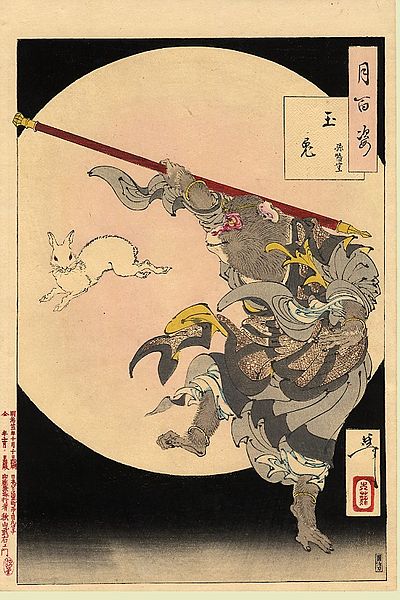 |
| Sun Wu Kung and Jade Rabbit. |
Tuesday, September 24, 2019
Reading Notes: Raja Rasalu, Part A
Story source: Tales of the Punjab by Flora Annie Steel, with illustrations by J. Lockwood Kipling (1894).
This week of readings is different from those to this point because I went in with no preconceived knowledge about this topic. It helped in some ways because I went in with such an open mind, but I definitely had to work a little harder to go through and comprehend all the readings.
The biggest reason for that is some of the language used in the stories. While the readings to this point had adaptations with more current language, the wording was clearly a little older and more difficult to understand. With that being said, I think I could turn some of these stories into a more 21st-century tale. The tales are also very unique in that they combine some parts of prose with some of poetry. This would definitely be an element worth keeping in mind when I write my story later this week.
I also think Raja Rasula is unique from some of the protagonists in that he's more independent as a hero. For example, Hector has a trusty sidekick in Paris, but when Raja Rasula shows his friends the creature that he killed while keeping guard overnight in "How Raja Rasula's Friends Forsook Him", they beg him for permission to return home. This protagonist is a hero capable of, and seemingly fine with, taking care of dangers to his people on his own.

Thursday, September 19, 2019
Reading Notes: Ancient Egypt, Part B
This part of the Ancient Egyptian readings made me realize just how different that mythology is from other cultures. For example, as I was reading through The Two Brothers, I was intrigued to find out what would happen after the pharaoh had the cedar tree cut down, killing Bata. I was unsure as to why her wife would ask the pharaoh to do that, but as I followed Anpu's journey, I remembered the idea of resurrecting him after finding his heart. What I was not aware of, however, was that Bata could be resurrected several times. That is definitely a unique aspect of Egyptian mythology that I want to keep in my story. I also really enjoyed watching the relationship of the brothers develop after being torn apart by a woman. The idea of forgiveness between the two in order to save the relationship they have is a theme you can see in all types of fruitful relationships, whether real or on paper.
 |
| A depiction of brothers Bata and Anpu facing off over the Canal of Ra. |
Wednesday, September 18, 2019
Reading Notes: Ancient Egypt, Part A
Story source: Egyptian Myth and Legend by Donald Mackenzie (1907).
Reading the first part of the Ancient Egypt, I was shocked in particular with the story of Osiris. I had learned in my past education that Osiris was the Egyptian god of the underworld, but I had not heard the story of his death before. It was interesting to learn about the good deeds he did for his people, and it reminded me to some extent of the kindness Jesus showed in some of the readings I explored from the Gospel of Mark unit. I also thought the manner in which he died, while original, was a little unorthodox. After all, his brother Set is a man of warfare like the story says, yet the plan for him and his conspirators is to trap Osiris in a coffin. I think I could definitely find a twist to that ending where Osiris is killed in a battle or doesn't die at all.
Reading the first part of the Ancient Egypt, I was shocked in particular with the story of Osiris. I had learned in my past education that Osiris was the Egyptian god of the underworld, but I had not heard the story of his death before. It was interesting to learn about the good deeds he did for his people, and it reminded me to some extent of the kindness Jesus showed in some of the readings I explored from the Gospel of Mark unit. I also thought the manner in which he died, while original, was a little unorthodox. After all, his brother Set is a man of warfare like the story says, yet the plan for him and his conspirators is to trap Osiris in a coffin. I think I could definitely find a twist to that ending where Osiris is killed in a battle or doesn't die at all.
 |
| A painting of the god Osiris from the tomb of Nefertari. |
Tuesday, September 10, 2019
Reading Notes: The Gospel of Mark, Part A
Story source: Gospel of Mark, King James Bible (1611).
This week of reading is a rather special one for me. A little insight: both of my parents grew up as Christians but strayed away from the religion as they got older. However, they always gave me the freedom to decide for myself what I believe in, and I grew up going to church occasionally with some of my best friends. While I do consider myself a Christian, I do not relate to any denomination in particular mainly because I was never fully immersed in the religion. I have also read parts of the Bible but never read it all the way through, which compelled me to read the Gospel of Mark for the first time.
While I knew several aspects of the Gospel of Mark beforehand, such as the crucifixion and resurrection of Jesus, there were also several parts of the story that I had never read about. I learned a lot about the path Jesus takes upon being announced as the Messiah, from teaching his disciples to the obstacles he has to overcome. One theme that is apparent throughout the Bible and this text is the idea of unwavering faith and acting upon it. Once Jesus is announced as the Son of God, he works to help people's illnesses, starvation, and more. While the idea of performing good deeds as repayment to God obviously is not transcendent across society, the idea of doing good out of the moral kindness is, and I think that's something I could touch on when writing my story later this week.
 |
| Leonardo da Vinci's The Last Supper |
Thursday, September 5, 2019
Reading Notes: Homer's Iliad, Part B
Story source: The Iliad retold by Alfred J. Church (1907).
The first thing that stood out to me when I read the second part of the Iliad readings was the appearance of Achilles in the story. I was immediately drawn into the story because I knew about Achilles' role in Greek mythology (fun fact: I suffered a bad ankle injury my junior year of high school, and the doctor told me I nearly tore my Achilles tendon as well). However, I had no idea he was in the Iliad. I was very intrigued by his relationship with Patroclus, who dies at the hands of Hector. The title, "The Rousing of Achilles" is very foreshadowing of what might happen later in the story.
I absolutely loved reading "The Slaying of Hector". This part of the story is jam-packed with action and ends, just as the title and the foreshadowing indicates, in Achilles killing Hector. Homer includes several similes throughout this chapter, including one where he describes the fury in which Achilles ran back to the battle as "swift as a racehorse". Homer also incorporates Apollo, who assists Hector in his escape, and Athena, who takes the shape of another figure and tricks Hector, into his story. I thought it was particularly interesting that Homer chose to have Hector run away from Achilles rather than fight him. While he concludes that this must be his fate, just as he told Andromache earlier in the story, it does seem a bit odd that he cowered so easily. I think it could be interesting to write a story while adding a twist where Hector does in fact stand up to Achilles. There's several different ways that could end.
I also wrote in my last blog about the love that Hector and Andromache share for each other. I thought it was interesting that Homer would include Andromache seeing Hector's dead body being dragged by the ships. The utter sadness she feels in that moment is also a sign a foreshadowing from when she was torn apart about him going back into the battle. The end of the Iliad texts reinforced the idea that I could potentially write the story from the perspective of Andromache.
 |
| A painting by Peter Paul Rubens depicting Hector's death at the hands of Achilles. |
Tuesday, September 3, 2019
Reading Notes: Homer's Iliad, Part A
Story source: The Iliad retold by Alfred J. Church (1907).
A few things stood out to me when I read the first part of the Iliad readings. Firstly, I was really intrigued by the relationship between Hector and his love, Andromache in the sixth part of the reading. While Hector is obviously a brave and powerful warrior, Andromache still worries that he might die in battle, abandoning her and their infant son, Astyanax. Yet, he stays true to the idea that if he is killed in battle by the Greeks, it it because "it be my fate to die". Hector cares tremendously for his son and even prays to the gods that he will turn out better than his father did. I could imagine writing a story from Andromache's perspective as a woman torn while the man she loves puts his life on the line for Troy. This is a little irrelevant to that relationship, but I also love the inclusion of Paris throughout the stories. It adds a real Batman and Robin feel to the story, and it even got me thinking about the idea of writing about their adventures together in battle.
In terms of the plot line, it was fairly easy to follow. The inclusion of several Greek gods throughout the story kept me engaged and helped me understand the historical context of the story. I also really liked some of the imagery in several of the stories. For example, in the first part of "The Quarrel", the writer describes the wrath with which Apollo descended from Olympus to avenge the priest, stating he "came as night comes across the sky". Furthermore, in Hector and Andromache, he compares Paris running to meet Hector to "a horse that is fresh from his stable, and prances over the grass and tosses his mane". I have always struggled to incorporate creative imagery like that in my writing, but reading through the first part of the Iliad stories definitely gave me some inspiration that I can carry over into the stories I write this semester.
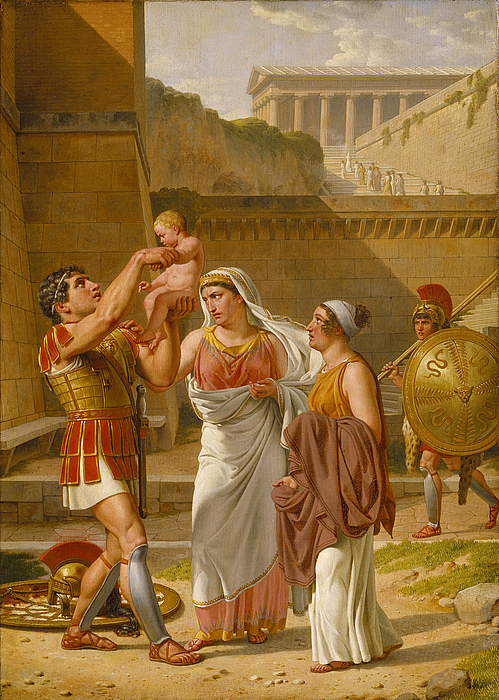 |
| A painting depicting Hector wishing farewell to Andromache and Astyanax. |
Thursday, August 29, 2019
Reading Notes: Week 2 Anthology
Story: Metamorphosis
To be honest, while I did read all the stories, I already had my eyes out for one in particular going into this assignment. Because of my interest in Greek mythology, I actually went out of order and read the Metamorphosis story first. I had never read anything about Pygmalion, so I had to do a little research beforehand to learn about his character. I enjoyed how he developed as the story progressed, from someone desperate for the perfect companion to a man with the love of his life. I also thought the story was very descriptive in several aspects, such as the creation of the sculpture and how it comes to life.
To be honest, while I did read all the stories, I already had my eyes out for one in particular going into this assignment. Because of my interest in Greek mythology, I actually went out of order and read the Metamorphosis story first. I had never read anything about Pygmalion, so I had to do a little research beforehand to learn about his character. I enjoyed how he developed as the story progressed, from someone desperate for the perfect companion to a man with the love of his life. I also thought the story was very descriptive in several aspects, such as the creation of the sculpture and how it comes to life.
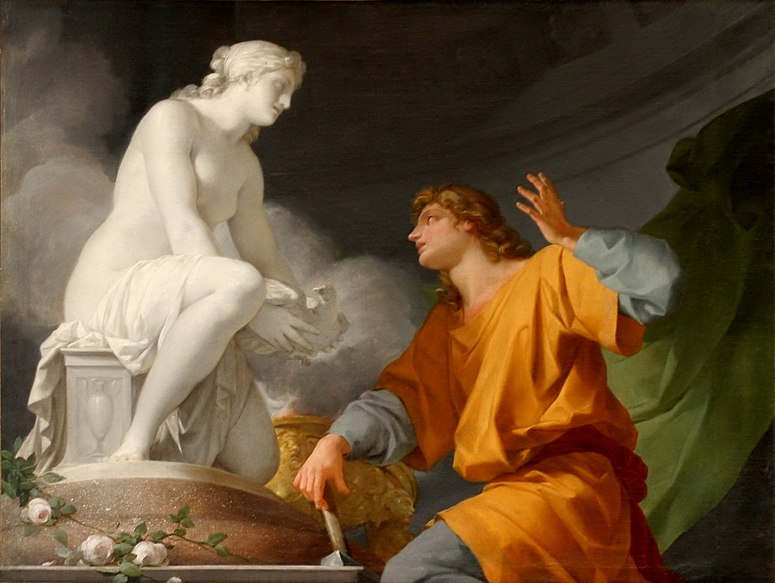 |
| A painting from French artist Jean-Baptiste Regnault depicting Pygmalion praying to Venus. |
Tuesday, August 27, 2019
Week 2 Reading Overview
Choose from CLASSICAL and/or BIBLICAL units for Weeks 3 and 4.
Week 3: Homer's Iliad
Week 4: Gospel of Mark
Choose from MIDDLE EASTERN and/or INDIAN units for Weeks 5 and 6.
Week 5: Ancient Egypt
Week 6: Raja Rasalu
Choose from ASIAN and/or AFRICAN units for Weeks 7 and 9.
Week 7: The Monkey King
Week 9: South Africa
Choose from NATIVE AMERICAN units for Weeks 10 and 11.
Week 10: Cherokee
Week 11: Hero Tales
Choose from BRITISH and/or CELTIC units for Weeks 12 and 13.
Week 12: Aesop's Fables
Week 13: Alice in Wonderland
Choose from EUROPEAN units for Weeks 14 and 15.
Week 14: Ashliman
Week 15: Dante's Inferno
I chose my reading units based on my previous high school studies. Even though my major is journalism, my favorite subject in high school was actually history. I've read a few of the readings that I chose, such as Aesop's Fables and Dante's Inferno. However, I haven't taken a history class since high school, and as I was going through all the choices, I realized that I forgot most of my knowledge on those subjects. I wanted to take this class to refine some of my knowledge in those areas, which affected many of my choices. I was also very excited when I saw the Cherokee reading as one of the options for the Native American units. My father's side of the family has Cherokee blood, but I never bothered to learn more about Cherokee history until now.
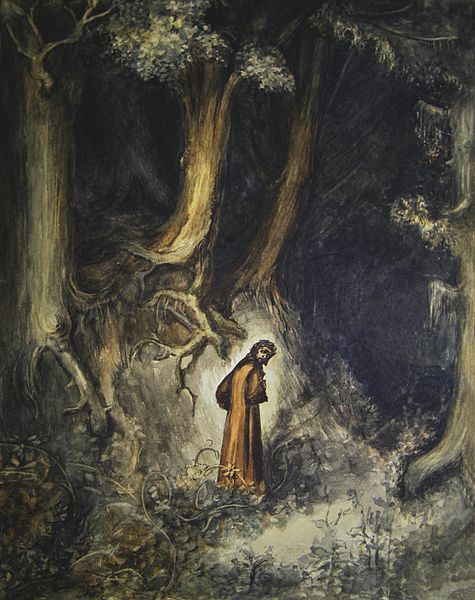 |
| A painting of Dante by Gustave Doré. Very excited to dive into the story again. |
Subscribe to:
Posts (Atom)
-
 Please leave your comments here, thanks! To check out my storybook project, click here . Fire by Liz West.
-
 My name is Sam Brown, and I am a senior at the University of Oklahoma from Plano, Texas. I'd consider myself fairly unique as one of the...
-
The great king Pygmalion had achieved more than enough in his lifetime. Yet, there was always something missing in the king's life. The ...


